

AI Memory Shortage Driving 30–50% Cost Increases in Fleet Video Systems, Safety Vision Industry Report Finds

Safety Vision Logo -
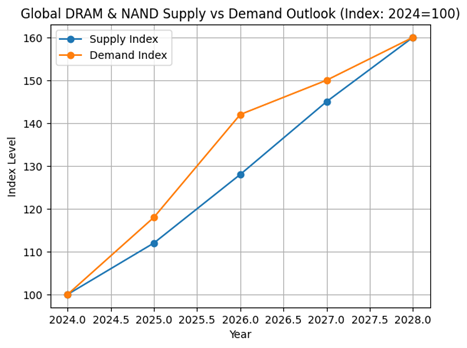
Source: IDC. Worldwide Semiconductor Supply vs Demand Outlook, 2025–2026

4112 Hybid Video Recorder
New research shows global NAND and DRAM shortages are reshaping mobile video surveillance across transit, school transportation, and commercial fleets.
The report, “Memory Constraints in Motion: How NAND & DRAM Shortages Are Reshaping Mobile Video Surveillance and Transportation Safety,” examines how rising semiconductor demand from artificial intelligence data centers is tightening global memory supply and increasing costs for edge technologies such as onboard vehicle video systems.
According to the report, memory prices are projected to increase 30% to 50% in 2026, while component lead times have expanded to 14–20 weeks or more, creating supply constraints across transportation safety technology deployments.
At the same time, the growing adoption of AI-powered safety systems—including driver monitoring, collision detection, and real-time fleet analytics—is significantly increasing memory requirements within mobile video platforms.
“Transportation fleets are adopting more advanced video and AI safety technologies at exactly the moment global memory supply is tightening,” the report notes. “That combination is forcing difficult tradeoffs between retention periods, video resolution, system capability, and overall cost.”
AI Demand Driving Global Memory Supply Shift
The report identifies three major forces driving the shortage:
1.) Rapid expansion of AI infrastructure, which is absorbing a growing share of global memory production
2.) Highly concentrated semiconductor manufacturing, where a small number of suppliers control most DRAM and NAND output
3.) Industry transitions to advanced memory architectures, temporarily limiting production capacity
As a result, memory—once considered a commodity component—has become a strategic constraint across many technology sectors.
In mobile video systems, memory now accounts for up to 30–40% of total system costs in some AI-enabled deployments.
Transportation Fleets Face Rising Costs and Deployment Delays
The report outlines several operational impacts already emerging across the transportation industry:
- Higher hardware costs for onboard video systems
- Longer procurement and deployment timelines
- Reduced video retention capacity due to storage cost pressures
- Slower adoption of AI-enabled safety analytics
For example, the report estimates that equipping a 500-bus fleet with mobile video systems could rise from approximately $3.75 million in 2024 to $4.8 million by 2026, while a 1,000-bus fleet could increase from $7.5 million to $9.75 million during the same period.
Industry Responds With Hybrid Storage and AI Efficiency
To adapt to the evolving supply environment, fleet technology providers are rapidly developing new strategies to reduce memory dependence while preserving safety performance.
These approaches include:
- Hybrid onboard and cloud storage architectures
- Event-based recording and intelligent data prioritization
- Advanced video compression technologies such as H.265 and H.266
- Hardware-as-a-Service and subscription deployment models
The report suggests these architectural shifts could permanently change how transportation safety systems are designed and deployed.
A Structural Shift for the Industry
While new semiconductor fabrication capacity is expected later in the decade, Safety Vision notes that the transportation industry is already adapting to a new reality where efficient data management and flexible system architectures will be essential.
Organizations that prioritize data efficiency, hybrid infrastructure, and resilient supply chains will be best positioned to maintain safety outcomes despite continued supply volatility.
“Memory shortages represent a structural shift in the technology ecosystem supporting fleet safety,” the report concludes. “The organizations that adapt now will maintain safety performance while those that delay may face higher costs and slower innovation cycles.”
The full report is available from Safety Vision.
The report reflects a broader shift occurring across transportation technology as AI-driven safety platforms generate unprecedented volumes of video and sensor data. As fleets deploy driver monitoring, ADAS analytics, and real-time safety management systems, efficient data architecture and scalable storage strategies are becoming central to fleet safety programs worldwide.
About Safety Vision
Safety Vision is a Houston-based provider of connected video, AI, and data intelligence solutions for commercial fleets, mass transit, and student transportation. For more than three decades, the company has delivered mobile video surveillance systems and cloud platforms that help organizations improve safety, accountability, and operational performance.
Safety Vision solutions integrate cameras, sensors, recorders, and software to transform vehicle and operational data into actionable insight—helping fleets protect people, reduce risk, and operate with greater confidence.
Learn more at www.safetyvision.com
Bill Rieck
Safety Vision, LLC
+1 713-929-1045
email us here
Visit us on social media:
LinkedIn
Instagram
Facebook
YouTube
X
Other
Safety Vision Cloud-Based Video Management System
Legal Disclaimer:
EIN Presswire provides this news content "as is" without warranty of any kind. We do not accept any responsibility or liability for the accuracy, content, images, videos, licenses, completeness, legality, or reliability of the information contained in this article. If you have any complaints or copyright issues related to this article, kindly contact the author above.
